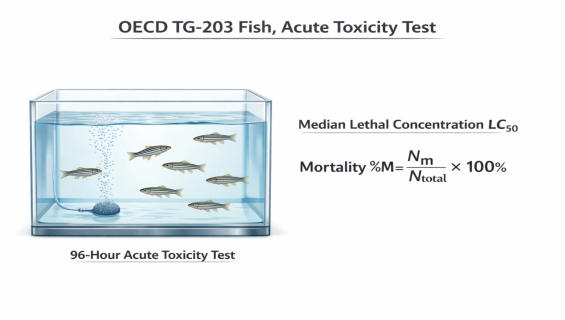
OECD TG-203 — Fish Acute Toxicity Test
In modern chemical management and the safety evaluation of water-contact devices, assessing the transient lethal effects of a substance on aquatic ecosystems is fundamental to overcoming environmental regulatory barriers. OECD TG 203 (Fish Acute Toxicity Test) stands as the internationally recognized "Gold Standard" for measuring acute hazards to aquatic organisms, directly determining a product's positioning within global GHS classifications.
1. Why Does Your Product Require an OECD TG-203 Study?
In the following critical scenarios, OECD TG 203 is a core requirement for EU REACH registration, US TSCA compliance, and pesticide market authorization:
-
Establishing Ecological Safety Baselines: Through 96 hours of continuous exposure, this test precisely defines the lethal threshold for vertebrate aquatic life. It serves as the first line of defense in assessing Environmental Fate.
-
Determining GHS Hazard Classification: The Median Lethal Concentration derived from this study is the legal basis for labeling products as "Toxic to Aquatic Life." Without this data, products may face severe distribution restrictions.
-
Clarifying Risk from Runoff and Leachates: For products likely to enter water bodies—such as pesticide adjuvants, external coatings, or industrial raw materials—TG 203 provides the most intuitive evidence of biological toxicity.
2. Technical Depth: Principles of Exposure and Observation
The scientific value of OECD TG 203 lies in its simulation of real-world aquatic exposure. The core operational elements include:
-
Standardized Test Species: Experiments typically utilize sensitive and representative species such as Zebrafish, Rainbow Trout, or Fathead Minnow. These species possess stable physiological traits that ensure global comparability of data.
-
Multi-Tier Concentration Gradients: By using a geometric series of concentration levels, we observe fish responses under varying stress levels and exposure durations.
-
Comprehensive Observation Indices: The study records more than just mortality; it includes monitoring for clinical signs of toxicity, such as loss of equilibrium, abnormal respiratory rates, changes in swimming behavior, or pigmentation shifts. These data assist toxicologists in determining the toxic Mode of Action (MoA).
- Test species
Zebrafish
The objective of this study is evaluation of the toxicity caused by test substance in in zebrafish. Young zebrafish will be exposed to at least five different concentrations of test substance. The mortality rate is recorded at the end of the experiment. According to these results, median lethal concentration(LC50) at 96 hours will be defined.
Click to Pay


