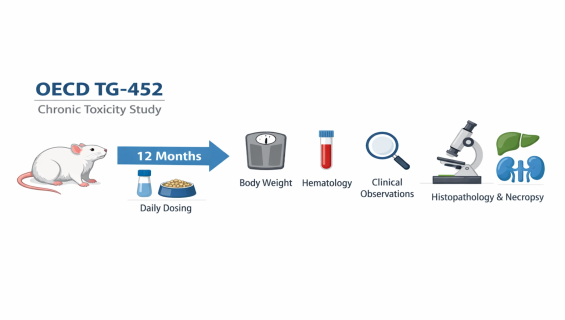
OECD TG-452 — Chronic Toxicity Studies
In the safety evaluation framework for chemicals and pharmaceuticals, understanding the damage caused by cumulative exposure over time is the cornerstone of protecting users from chronic health risks. OECD TG 452 is the internationally recognized standard for assessing long-term exposure toxicity, designed to identify the profound impacts of a substance on target organs, physiological functions, and biochemical metabolism throughout a major portion of a lifespan.
1. Why Does Your Product Require an OECD TG 452 Study?
Chronic toxicity data is a critical source for human health risk assessments and the establishment of legal exposure limits:
-
Precise Derivation of NOAEL: Through a 12-month continuous exposure period, we can accurately identify the "No-Observed-Adverse-Effect Level (NOAEL)," which serves as the scientific starting point for setting Tolerable Daily Intake (TDI) or Acceptable Daily Intake (ADI).
-
Detecting Cumulative Organ Damage: Many toxic effects remain undetected in short-term studies (28 or 90 days). TG 452 captures slow-progressing conditions such as chronic liver/renal failure, endocrine disruption, or chronic tissue degeneration.
-
Meeting Global Regulatory Demands: For high-volume chemicals, specific pesticides, and long-term medications, this study is a core technical requirement for dossiers submitted to EU REACH, US EPA, and global food safety authorities.
2. Technical Depth: Long-term Physiological Monitoring
The scientific rigor of OECD TG 452 is demonstrated by its comprehensive tracking of physiological and molecular changes:
-
12-Month Observation Window: Typically performed in rodents (e.g., rats), the observation period lasts at least 12 months. This ensures sufficient time for the development of clinical signs and allows for the observation of substance interactions with aging physiology.
-
Systematic Clinical Biochemistry Monitoring: Regular collection of blood and urine samples to analyze dozens of biomarkers (e.g., liver enzymes, renal metabolites, electrolytes, and hematology), establishing a dynamic profile of toxic progression.
-
In-depth Histopathological Analysis: Upon study termination, a thorough micro-dissection and pathological examination of all major organs are performed. Compared to sub-chronic tests, TG 452 provides significantly deeper data on chronic pathological shifts.
3. Your Premier Regulatory and Testing Partner
Executing OECD TG 452 requires extreme environmental stability and expert clinical pathways. We provide the following values:
-
GLP-Compliant Data Integrity: Throughout the one-year study period, we maintain rigorous 24/7 environmental control and data logging. Our reports possess international mutual recognition (MAD), facilitating direct entry into global markets.
-
Customized Dosing and Exposure Routes: Tailored to your product’s profile (oral, dermal, or inhalation), we design protocols that best mimic actual human exposure pathways, maximizing the predictive value of the data.
-
Integrated Chronic & Carcinogenicity Studies (TG 453): We possess the capability to perform combined studies, generating both chronic toxicity and carcinogenicity data within a single experimental framework, helping you fulfill high-level regulatory requirements cost-effectively.
Click to Pay


