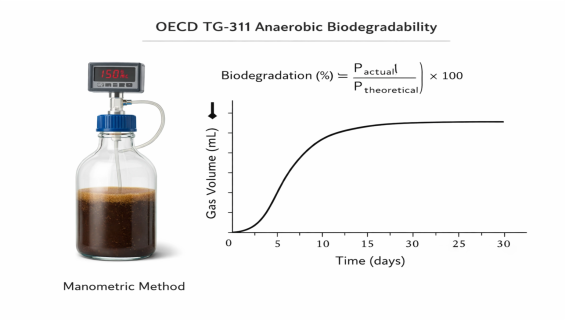
OECD TG-311 — Anaerobic Biodegradability in Digested Sludge: Gas Production Method
When assessing the long-term environmental fate of chemicals, biodegradability in oxygen-deprived environments—such as sewage sludge digesters, deep soils, or sediments—is often overlooked. OECD TG 311 is a high-level assay specifically designed for "anaerobic environments." By monitoring the total gas production generated during microbial decomposition, it identifies the ultimate anaerobic biodegradability of a test substance.
1. Why Does Your Product Require an OECD TG 311 Study?
For chemicals likely to partition into anoxic environments, TG 311 is a core requirement for completing an Environmental Risk Assessment (ERA):
-
Identifying Persistence in Anoxic Conditions: Many substances that degrade easily under aerobic conditions may persist indefinitely in anaerobic environments. TG 311 completes the "Environmental Fate" profile, preventing products from being inaccurately classified as Persistent (PBT).
-
Simulating Sludge Digester Efficiency: For industrial chemicals or detergent ingredients, TG 311 predicts the removal rate during the anaerobic digestion phase of a wastewater treatment plant, which is vital for setting industrial discharge standards.
-
Assessing Impacts on Methane Production: Beyond degradation data, this test monitors whether a substance inhibits methanogenic activity, helping clients evaluate biosafety when developing bioenergy (biogas) related products.
2. Technical Depth: Principles of Total Gas Production and Carbon Conversion
The scientific core of OECD TG 311 lies in the precise quantification of anaerobic metabolic end-products:
-
Sealed Anaerobic Systems: The test substance is mixed with digested sludge from a wastewater treatment plant and kept in strictly deoxygenated, sealed vessels to mimic real-world anoxic degradation.
-
Monitoring Gas Production Kinetics: The process of microbial conversion of organic carbon into Methane ($CH_4$) and Carbon Dioxide ($CO_2$) is continuously recorded. The biodegradation percentage is determined by calculating the ratio of actual gas produced to the Theoretical Gas Production ($ThGP$).
-
Dissolved Inorganic Carbon (DIC) Analysis: At the end of the study, DIC in the aqueous phase is analyzed to ensure all degradation products—including $CO_2$ dissolved in the liquid—are accurately accounted for, preventing any underestimation of biodegradability.
3. Your Premier Regulatory and Testing Partner
Executing OECD TG 311 requires sophisticated anaerobic techniques and long-term stability in water quality management. We provide the following professional values:
-
GLP-Compliant Data Excellence: Our protocols strictly adhere to international GLP standards. Our reports carry international mutual recognition, serving as authoritative evidence for technical inquiries from global environmental agencies.
-
High-Sensitivity Gas Analysis: Utilizing precision pressure transducers or Gas Chromatography (GC), we ensure that even trace amounts of gas production are accurately captured.
-
Expert Regulatory Consulting: We assist in interpreting degradation data and its impact on REACH registration or GHS classification, ensuring your product maintains a competitive advantage in the global market.
Click to Pay


