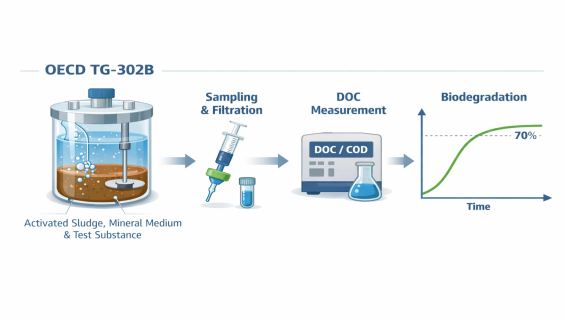
OECD TG-302B — Inherent Biodegradability: Zahn-Wellens/EMPA Test
When assessing the long-term environmental impact of chemicals, understanding whether a substance possesses "potential biodegradability" is crucial. OECD TG-302B is a high-sensitivity assay that simulates high-density microbial environments to identify whether a substance can be biodegraded under optimized conditions, thereby evaluating its removal efficiency in Sewage Treatment Plants (STPs).
1. Why Does Your Product Require an OECD TG-302B Study?
Not all chemicals pass the preliminary Ready Biodegradability tests (OECD 301). When a product is classified as "not readily biodegradable," TG-302B serves as a critical tool for providing advanced evidence:
-
Identifying Potential Degradability: Many substances that resist decomposition in low-density natural waters can be effectively removed in the high-activity sludge environment of an STP. This test demonstrates that a substance is not "Environmentally Persistent."
-
Evaluating Wastewater Removal Rates: For industrial raw materials or wastewater discharges, TG-302B data predicts the proportion of the substance that will be degraded or adsorbed upon entering public sewage systems.
-
Optimizing GHS Hazard Classification: Proving inherent biodegradability can serve as scientific justification for mitigating the long-term aquatic environmental hazard classification of a product.
2. Technical Depth: Monitoring DOC Removal and Adsorption
The uniqueness of OECD TG-302B lies in providing an ideal environment for "full contact" between microbes and chemicals:
-
High Inoculum Concentration: Utilizing high concentrations of activated sludge (0.2 to 1.0 g/L of suspended solids), the test monitors the substance for up to 28 days under controlled stirring and aeration.
-
Dissolved Organic Carbon (DOC) Analysis: Degradation percentages are calculated by periodically sampling and analyzing the decrease in DOC. This method accurately reflects the disappearance of the carbon backbone rather than mere physical transformation.
-
Distinguishing Adsorption from Biodegradation: The reduction in DOC within the first 3 hours is typically attributed to "physical adsorption," while subsequent reductions represent true "biodegradation"—a distinction vital for assessing the environmental fate of a substance.
3. Your Premier Regulatory and Testing Partner
Executing OECD TG-302B requires stable sludge activity management and precise carbon analysis. We provide the following values:
-
GLP-Compliant Data Integrity: Our experimental protocols strictly adhere to international GLP standards, ensuring that reports possess international mutual recognition—the best solution for responding to technical inquiries from national EPAs.
-
Customized Study Durations: Based on substance properties, the observation period can be flexibly extended (beyond 28 days) to capture degradation signals from substances with longer lag phases.
-
Regulatory Consulting for Market Access: We assist in integrating degradation data into SDS and environmental risk reports, ensuring your product enters the industrial supply chain with complete regulatory endorsement.
Click to Pay


