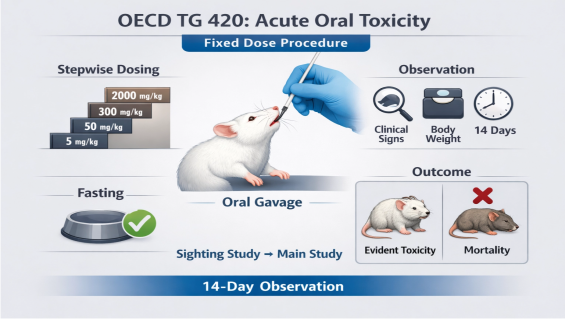
OECD TG 420: Acute Oral Toxicity - Fixed Dose Procedure
Accurate determination of acute oral toxicity is a fundamental step in product safety classification. Adhering to OECD TG 420 guidelines and GLP principles, we utilize the "Fixed Dose Procedure" to provide reliable toxicity grading for your products. This method not only meets international regulatory requirements but also fulfills corporate social responsibility by minimizing animal usage and distress.
Study Objective
To evaluate the health effects resulting from a single oral administration of a test substance within a short timeframe. By observing "evident toxicity" rather than mortality, this study identifies the GHS toxicity category and estimates the lethal dose range.
Service Highlights & Technical Specifications
-
Enhanced Animal Welfare: Unlike traditional $LD_{50}$ tests, this procedure uses evident clinical signs of toxicity as the endpoint, significantly reducing animal mortality.
-
Tiered Dose Design: Utilizing fixed dose levels (5, 50, 300, 2000, or optionally 5000 mg/kg) to precisely pinpoint the toxicity interval.
-
Expert Clinical Observation: Intensive 14-day observation by senior toxicologists, recording behavioral changes, respiratory patterns, tremors, and abnormal excretions.
-
Gross Necropsy: Comprehensive post-mortem examination of all test animals to identify any macroscopic lesions in internal organs (e.g., liver, kidneys, gastrointestinal tract).
Study Procedure
-
Sighting Study: A preliminary test using a single animal to select the appropriate starting dose for the main study.
-
Main Study: Administration of the selected dose level to a group of animals (typically female rats).
-
Observation & Recording: Intensive monitoring during the first 24 hours post-dosing, with continuous tracking up to Day 14.
-
Reporting: Delivery of a formal GLP report featuring body weight curves, clinical sign descriptions, and recommended GHS classifications.
Targeted Industries
-
GHS Classification and Labeling for Safety Data Sheets (SDS/MSDS)
-
Registration of Pesticides, Environmental Agents, and Specialty Chemicals
-
Safety Assessment of Food Additives and Novel Ingredients
-
Global Regulatory Submissions (e.g., REACH, K-REACH, TSCA)
Click to Pay


